
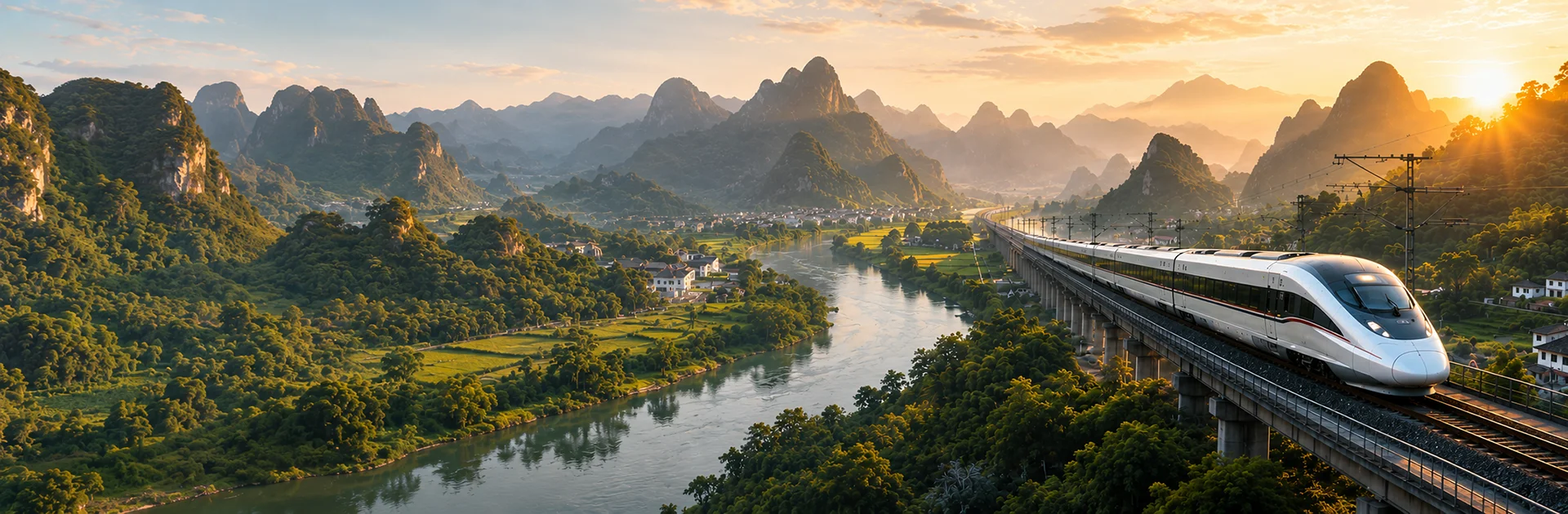
Overview
A lot of people rush through Guiyang on the way to somewhere else. That's a mistake, but an understandable one — Guizhou province is packed with distractions (Miao villages, Huangguoshu Waterfall, the karst formations of Libo) and Guiyang itself doesn't scream for attention. What it does is eat. Guiyang has one of the most distinctive food scenes in China, built around sour-spicy flavors that don't exist anywhere else.
Give it one full day as a city stop, or 2-3 days as a base for Guizhou exploration. Day 1: Jiaxiu Pavilion, Qianling Park (wild monkeys roam free), and a sour fish hotpot dinner. Days 2-3: day trips to Qingyan Ancient Town (30km), Huangguoshu Waterfall (2h by train), or the Miao villages of Xijiang.
The city sits at 1,100m on the Yunnan-Guizhou Plateau. Summers are mild by Chinese standards — while Chongqing and Wuhan roast, Guiyang stays in the 20s (Celsius). Locals call it the "Summer Capital" and they're not wrong.
Train connections: Guiyang is the southwest hub. Chongqing (2h), Chengdu (3.5h), Kunming (2h), Guangzhou (4.5h), Guilin (2h). It connects Sichuan to Guangxi to Yunnan — the missing link on most mental maps of Chinese rail.
Need help planning your Guiyang trip?
We help international travelers plan China train routes, book tickets, and build practical Guiyang itineraries.
Best Time to Visit Guiyang
Best months: April to May and September to October. Spring is green and rainy but the temperature is perfect, 15-22C (59-72F). September is the sweet spot — dry, clear, the rice terraces turning gold. Avoid the rainy season peak (June-July) unless you enjoy walking in drizzle.
Summer (June-August) is Guiyang's calling card. While the rest of China swelters, Guiyang averages 23-28C (73-82F). It rains a lot, but it's a soft rain — misty rather than torrential. This is why Chinese tourists flood the city in July-August.
Winter (December-February) is cold and damp, 2-8C (36-46F). No central heating in many buildings. The grey weather matches the grey concrete but the hotpot tastes better in the cold.
The local joke: Guiyang has three kinds of weather — raining, about to rain, and just stopped raining. Bring a rain jacket regardless of season.
What to Eat in Guiyang
Guizhou food is sour-spicy (酸辣). Not Sichuan numbing-spicy, not Hunan raw-spicy — sour-spicy. The sourness comes from fermented vegetables and tomatoes, the heat from local chilies, and the combination is addictive.
Must-try: Suan tang yu (酸汤鱼) — sour fish hotpot. The broth is fermented rice water with tomatoes, chili, and wild herbs. Whole river fish poached at the table. 80-150 CNY for two people. This is the dish Guiyang is built around. Laokaili (老凯里) is the famous restaurant; any place with a queue does it well.
Chang wang mian (肠旺面) — pork intestine and blood curd noodles. Sounds intimidating, tastes rich and spicy. 10-15 CNY. A Guiyang breakfast staple. Best from street stalls in the morning.
Si wawa (丝娃娃) — literally "silk doll." DIY rice paper rolls filled with shredded vegetables, peanuts, and sour-spicy sauce. 15-25 CNY. The street version on Qingyun Road is the real experience.
Huaxi niu rou fen (花溪牛肉粉) — beef rice noodles from Huaxi district. Rich broth, thin-sliced beef, pickled vegetables. 12-18 CNY.
Best food areas: Qingyun Road night market for street food. The area around Jiaxiu Pavilion for sit-down restaurants with a view. Erqi Road snack street for variety.
How to Get Around Guiyang
Guiyang's metro is small but growing: 3 lines covering the main urban corridor. Line 1 connects Guiyang North Station to the city center. Alipay or WeChat Pay to tap in.
Didi works well and is cheap — 15-25 CNY for most city trips. Traffic is worse than you'd expect for a city this size because Guiyang is built in a narrow valley. Rush hour (8-9am, 5:30-7pm) can double journey times.
From the airport: Guiyang Longdongbao Airport is 11km east of the city. Metro Line 2 connects the airport to the center (25 minutes, 7 CNY). Didi costs 40-60 CNY.
The city is spread out along its valley, so east-west travel takes time. The metro is your friend for longer hops.
Arriving in Guiyang by Train
Guiyang North Station (贵阳北站) — the main high-speed station. Handles trains to Chongqing (2h), Chengdu (3.5h), Kunming (2h), Guangzhou (4.5h), Guilin (2h), Changsha (3h). Metro Line 1 connects directly to the city center. Modern and well-organized. Arrive 30-40 minutes early.
Guiyang East Station (贵阳东站) — a secondary high-speed station on the eastern side. Some Chengdu-Guiyang and Guiyang-Guangzhou trains use this station. Check your ticket carefully — East and North stations are 15km apart.
Guiyang Station (贵阳站) — the old downtown station. Now mainly conventional trains. Metro Line 1. Convenient location near the center but limited services.
For foreigners: Guiyang North is your station 90% of the time. The manual ticket counter handles foreign passports; self-service machines are inconsistent.